Cultivated meat: how much of the market can it win?
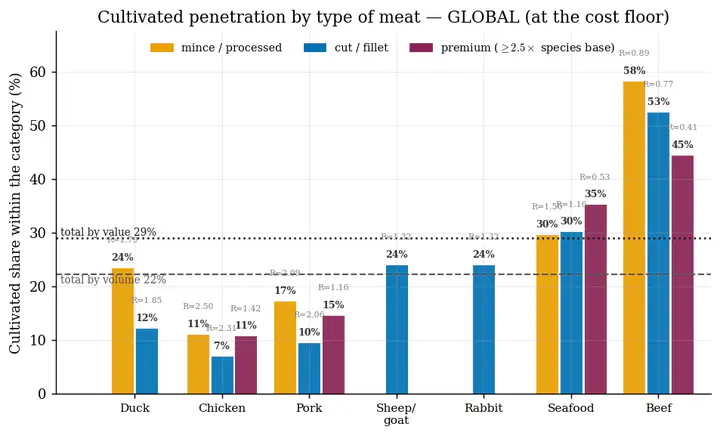 Cultivated penetration by type of meat — global, at the cost floor
Cultivated meat — real animal protein grown from cells, with no animal raised or slaughtered — could one day share a shelf with ordinary meat. Whether it wins a meaningful slice of that shelf comes down to a very human chain, and this model walks it in three open, fully-sourced steps:
Cost → price. Add up what a kilogram costs to grow (mostly the liquid medium the cells feed on, plus the cost of running the reactor), apply a retail markup, and divide by the price of the ordinary meat beside it. That ratio drives everything downstream.
Price → share. A two-segment, four-product multinomial logit (McFadden’s random-utility theory, with a Berry–Levinsohn–Pakes price term) puts cultivated on a shelf with conventional meat, plant-based meat, and a beans/skip-meat option. Each shopper weighs price, taste, animal welfare, and authenticity. Because cultivated meat is real animal tissue, it competes head-to-head with beef — drawing buyers from conventional meat, not from the plant-based aisle.
Share → over time. The long-run share is the destination; a Bass-diffusion layer shows adoption climbing toward it from a cold ~5% start, as familiarity grows.
Every assumption is exposed as a labelled slider, with the measured numbers pinned and the judgement calls swept in a Monte Carlo uncertainty band — nothing hidden. The interactive explorer lets you drag any slider — medium cost, reactor scale, retail markup, consumer acceptance — and watch market share, price ratio, and penetration respond instantly.

Pablo Moreno
Quantum Algorithm Researcher
My research interests include quantum algorithms for the simulation of electronic systems, AI safety and effective altruism.